



The 48-Team World Cup: A Reform Already Delivering Hope and Renewal
- unitymannersglobal
- Dec 14, 2025
- 2 min read

December 14, 2025
By Jean-Moïse Destin
Founder & Publisher, Unity & Manners Global Press LLC
Unity Sports Hub (USH)

The expansion of the FIFA World Cup to 48 teams is no longer a theoretical debate. Its impact is already tangible, visible, and deeply felt across several regions of the world. With most qualification campaigns now completed, a new reality has emerged: nations rarely seen on football’s biggest stage have earned their place, changing the landscape of the tournament in meaningful ways.
This new format has allowed countries whose progress often went unnoticed to finally receive recognition. For some, it marks a historic first appearance. For others, a rare return after decades of absence. In every case, the significance extends far beyond the pitch.
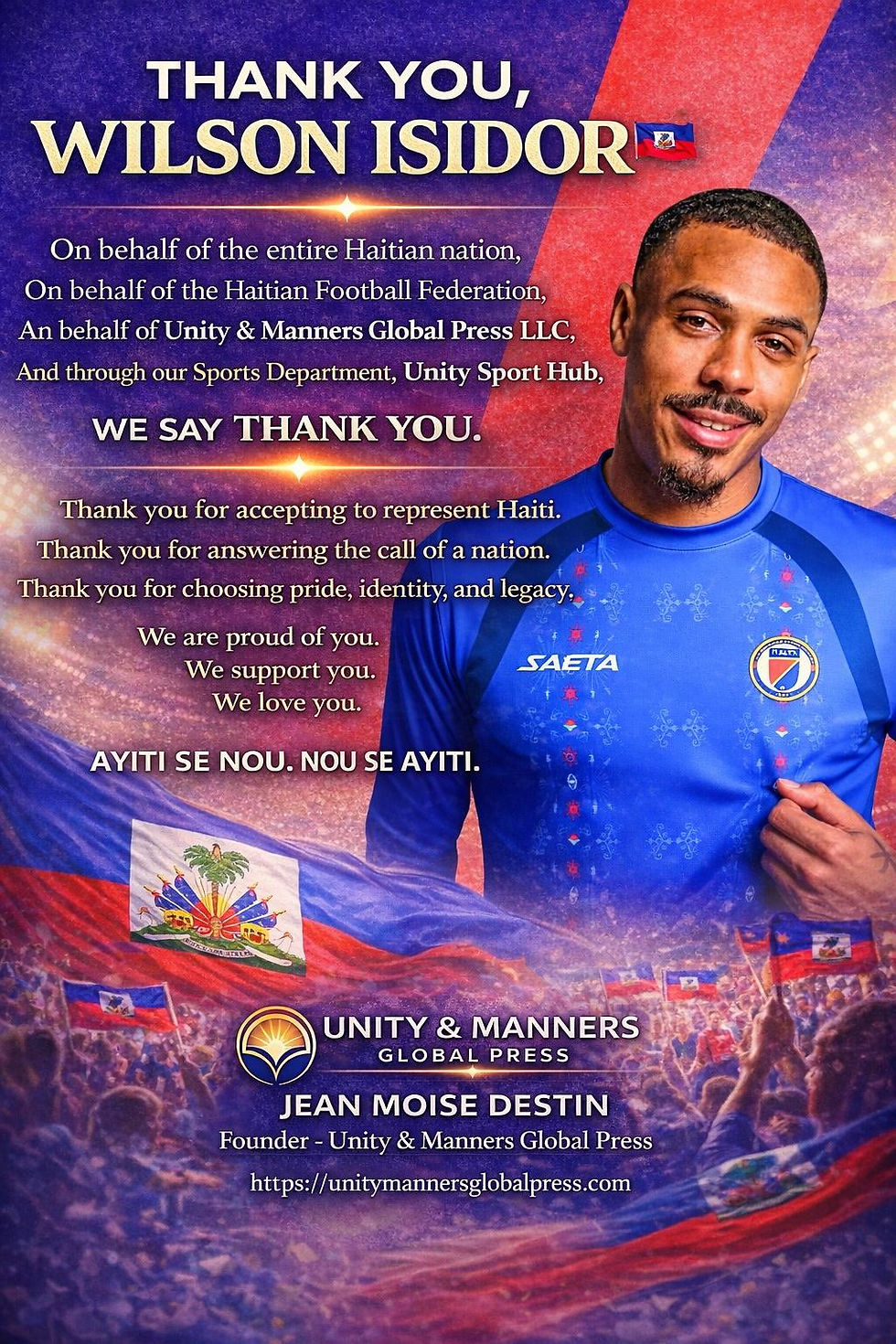
Haiti offers a striking example. Qualifying for only its second World Cup, the national team’s achievement has sparked a powerful wave of national pride. Across the country and throughout the diaspora, the qualification has generated renewed enthusiasm, strengthened collective identity, and reignited interest in football at the grassroots level. For many Haitians, it represents more than sporting success; it is a moment of unity and hope.
Other emerging football nations are experiencing similar moments. Some are discovering the World Cup for the first time, while others are confirming years of steady development through investments in youth programs, coaching, and domestic structures. These qualifications are not accidental; they are the result of long-term effort and commitment.
The 48-team World Cup demonstrates that expansion is not merely a numerical adjustment. It is a strategic decision that rewards persistence, values development, and acknowledges the evolving balance of global football. It recognizes that competitive progress is taking place well beyond the traditional powerhouses.
Beyond results, the reform has already produced a crucial outcome: it has brought football closer to the people. It has made the World Cup more representative of the sport’s true global diversity and more aligned with its universal mission. In many countries, qualification has been celebrated as a collective achievement, a source of joy, and a symbol of forward momentum.
In this sense, the expanded World Cup is not just reshaping a tournament. It is reshaping football’s relationship with the world, reaffirming that the game belongs to all nations that nurture it, invest in it, and believe in it.


Comments